Car Rental With Rooftop Tent in Kenya
Rent a fully equipped 4×4 with a rooftop tent in Kenya and turn your vehicle into your basecamp for a self-drive safari or road trip. Self Drive Kenya rents 4×4 vehicles, principally Land Cruiser Hardtops, Land Cruiser LX models and Land Cruiser V8s, fitted with a factory-mounted rooftop tent, in three configurations: a single rooftop tent for one or two people travelling light, a double rooftop tent set-up for couples and small families needing two sleeping compartments, and a family rooftop tent that sleeps up to three people in one expanded tent. Camping equipment: cooking gear, table and chairs, fridge & lighting is available as an add-on package rather than a blanket inclusion, so you build the exact kit your trip needs.
 Vehicles can be self-driven or driven by one of our professional driver guides, and can travel throughout Kenya and, on pre-approved rentals, across the border into Tanzania, Uganda and Rwanda. Rates depend on vehicle class, tent configuration, rental duration and equipment tier, and every rental runs on a signed agreement that explicitly covers rooftop tent and camping use, we do not rent camping vehicles on paperwork that does not name them.
At a glance, every rooftop-tent rental from Self Drive Kenya includes a prepared 4×4 safari vehicle, a rooftop tent sized to your group, a camping equipment package selected to your chosen tier, the option of self-drive or a professional driver-guide, approved routes across Kenya and into neighbouring East Africa, and local, on-call support for the length of your trip
Sleep Above the Wild. Drive Into It Every Morning.
There is a particular kind of quiet that only exists when you wake up inside a rooftop tent on the edge of the Masai Mara, canvas still cool from the night, and the first sound you hear is not traffic or a hotel corridor but a lion somewhere out past the acacias, answered a few seconds later by another, further off. You unzip the flap, and the plain is already gold. Nobody else in camp is awake yet. You made the decision to be here, at this exact spot, at this exact hour, because you were driving your own vehicle, on your own itinerary, and you chose to stop here rather than somewhere a shuttle bus timetable chose for you.
That is what a car rental with rooftop tent in Kenya actually buys you. Not a gimmick, not a photograph for the feed, but authorship over your own Kenya safari. Renting a fully equipped 4×4 fitted with a rooftop tent turns your vehicle into a mobile basecamp, so instead of booking a lodge every third night and shaping your route around check-in times, you carry your accommodation with you and camp wherever the day’s driving happens to end, beside the Mara River, under the shadow of Kilimanjaro in Amboseli, deep in the red dust of Tsavo, on the shores of Lake Naivasha, or on the coast outside Watamu with the sound of the Indian Ocean instead of the bush. At Self Drive Kenya, we prepare, maintain and hand over 4×4 rooftop-tent vehicles built specifically for this kind of independent, self-drive safari and road-trip camping, for solo travelers, couples, families and small groups travelling together, with camping equipment packages to match whichever way you want to travel.
Is a Rooftop-Tent Self-Drive Right for You?
For the solo traveller
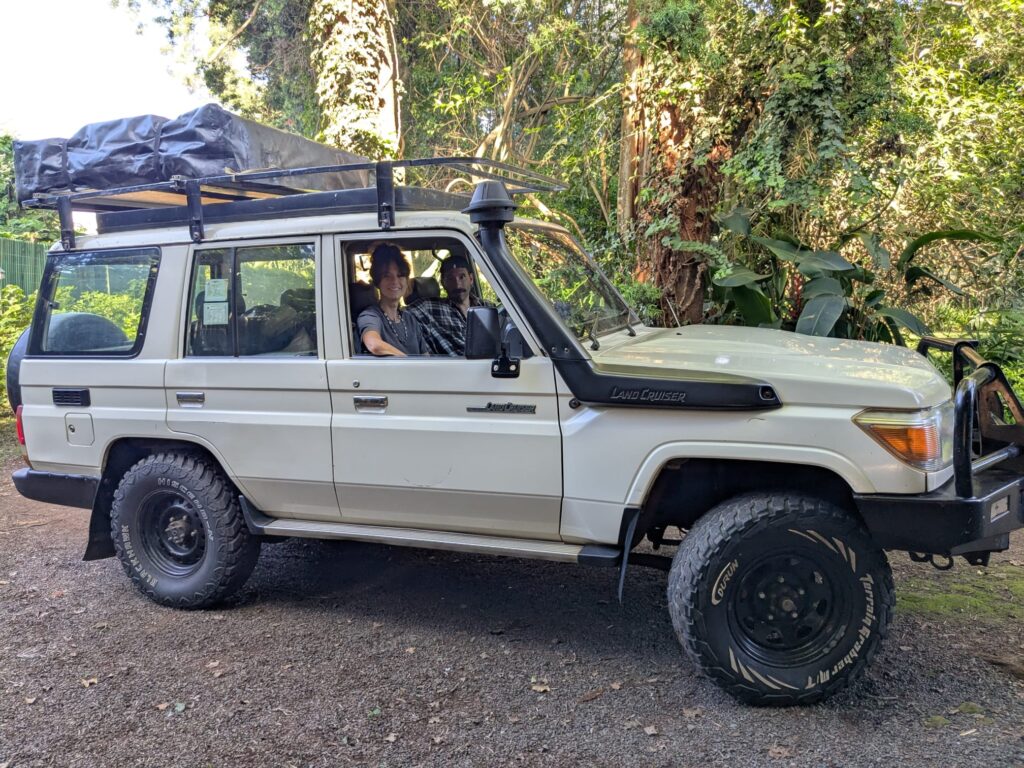
Travelling Kenya alone in a rooftop-tent vehicle is one of the most self-sufficient ways to see the country. You are not waiting on a group’s pace, not paying for a second berth you don’t use, and not restricted to towns with backpacker hostels. A single rooftop tent on a Land Cruiser Hardtop gives you a proper bed, off the ground and away from anything that moves at night, parked wherever your day’s drive naturally ends. Most solo clients choose a shorter equipment package including: cooking basics and a camp chair rather than the full kitchen set-up, and either self-drive on well-marked routes or take a driver-guide for the first trip if this is their first time behind the wheel in East Africa.
For couples
A couple traveling together is, in our experience, the ideal fit for this style of trip. A double rooftop tent or a well-specified single tent gives you a real mattress, real privacy, and the freedom to decide over breakfast that you are staying an extra night at Lake Naivasha instead of pushing on to Nakuru. Vehicles like the Land Cruiser LX carry enough fuel and luggage range for a two-to-three-week loop through the Mara, Amboseli and the coast without needing to backtrack for supplies more than once or twice.
For families
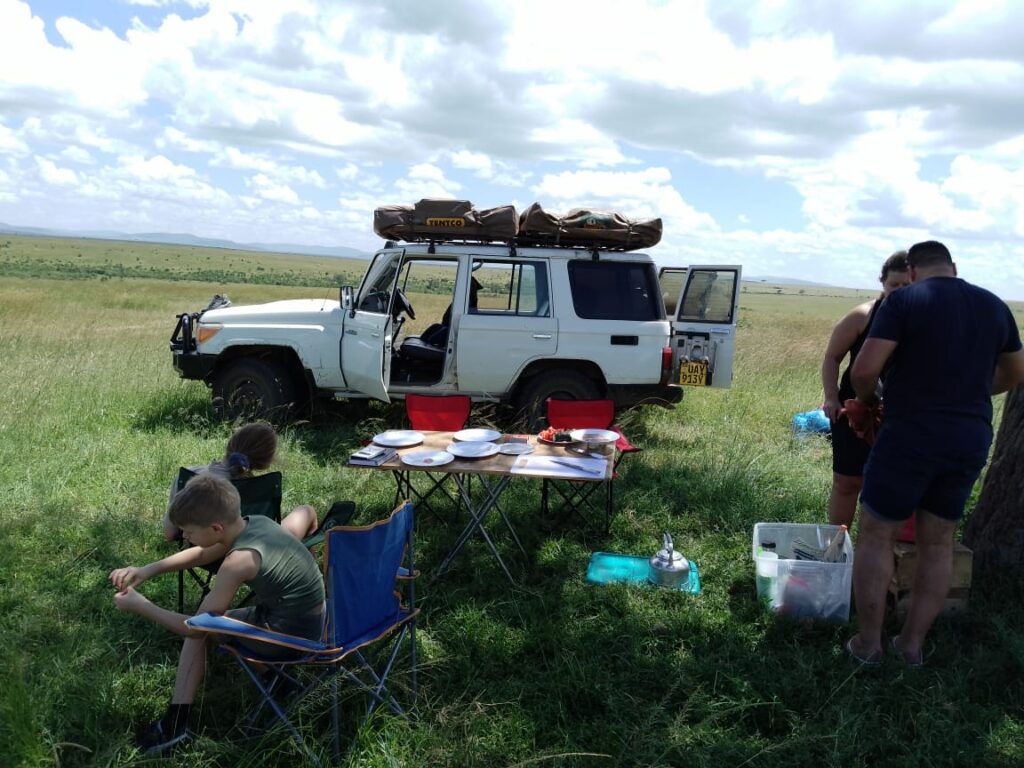
Families are why we built the family rooftop-tent configuration in the first place. It sleeps up to three, so a couple with one or two younger children can share the roof tent while older kids or an additional adult use a ground tent or a second vehicle’s tent on multi-vehicle bookings. A a larger Land Cruiser LX gives you the load capacity for a proper family camping kit, a fridge for the children’s food and drinks, a larger table and chair set, extra water storage, and the safety margin of a well-serviced, heavy-duty 4×4 on Kenya’s rougher park tracks.
For small groups
Groups of friends travelling together typically book two or three vehicles, each with a double or family rooftop tent, and either self-drive as a convoy or take one or two driver-guides to lead the route and handle park logistics. This is the format we recommend for groups planning a longer loop into Tanzania or Uganda, since a driver-guide who already knows the border posts and park gate procedures removes almost all of the friction from a multi-country trip.
Choose Your Rooftop-Tent Setup
Single Rooftop Tent
Built for one or two people who want a straightforward, lightweight camping set-up. Mounted on a Land Cruiser Hardtop, it opens in minutes, holds a proper foam mattress, and gives you enough headroom to sit up and dress comfortably. This is our most affordable configuration and the one most solo travellers and minimalist couples choose.
Double Rooftop Tent
Two independent tent compartments on one vehicle, ideal for a couple who want more sleeping and storage space, or two friends travelling together who each want their own tent without needing a second vehicle. This configuration is available on the Land Cruiser LX and works well for trips that mix camping nights with the occasional lodge or tented-camp stay.
Family Rooftop Tent
An expanded tent that comfortably sleeps up to three people, designed for a couple with a child or for three adults travelling together. Paired with a Land Cruiser V8 or a larger LX, this is the configuration with the most interior luggage space remaining for camping equipment, cool boxes and extra water,an important detail on longer routes into Tsavo or Samburu where the next proper supermarket may be a full day’s drive away.
Our Rooftop-Tent Vehicles For Kenya Safaris
Our rooftop-tent fleet is built around Toyota Land Cruisers, the vehicle every serious Kenyan safari operator and overlander defaults to, for the same reason we do: parts and mechanics for Land Cruisers exist in every town from Nairobi to Marsabit, and the four-wheel-drive system copes with the black-cotton mud of the Mara in the rains and the corrugated tracks of Tsavo in the dry season without complaint.
Land Cruiser Hardtop With Rooftop Tent
The Land Cruiser Hardtop is our most popular self-drive rooftop-tent vehicle: rugged, mechanically simple, easy to drive on rough tracks, and right-sized for a single or double tent configuration. It is the vehicle we recommend most often to first-time Kenya self-drivers.

LX Land Cruiser With 2 Rooftop Tents
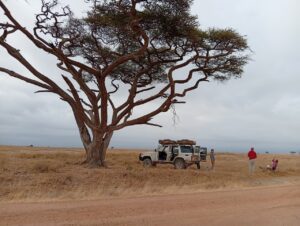
The Land Cruiser LX steps up in comfort and interior space, with a smoother ride on tarmac between parks and enough capacity for a double or family tent plus a full camping equipment package. Couples and small families doing a two-to-three-week Kenya loop tend to gravitate here.
.
V8 Land Cruiser With 1 Rooftop Tent
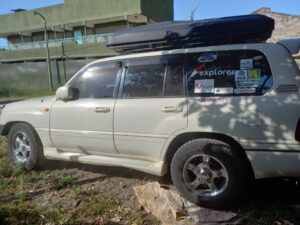
The Land Cruiser V8 is our top-tier option: the most power for long tarmac stretches and steep park approaches, the most interior room, and the vehicle we put families and small groups in when the itinerary includes a cross-border leg into Tanzania or a long push north to Samburu Or Nanyuki region.
We are also happy to advise on other 4×4 options in the fleet where a rooftop tent can be fitted to suit a specific budget or group size — get in touch with your exact traveller count and route and we will recommend the closest match rather than the most expensive option
What Is a Rooftop Tent, Really?
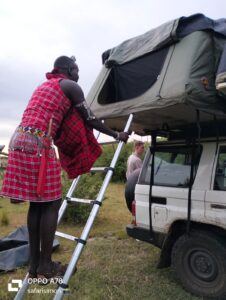
A rooftop tent is a folding canvas tent mounted permanently on a roof rack, built around a rigid base and a proper foam mattress, that unfolds upward and outward in a few minutes using a ladder that doubles as your access point. It is not a tent you pitch on the ground; it stays attached to the vehicle the entire trip, so setting up and breaking camp is a matter of minutes rather than the twenty-to-thirty-minute process of a traditional ground tent. Because it sits a metre or more above the ground, it keeps you off damp or uneven ground, above the reach of most insects and small animals, and, this matters more in Kenya than almost anywhere else, off the ground entirely in areas where wildlife moves freely through unfenced campsites at night. Most rooftop tents used on our fleet are built for genuine four-season use, with a rainfly, mesh ventilation panels for hot nights, and enough structural rigidity to sit comfortably through a Mara thunderstorm without leaking.
The trade-off, and we tell every client this upfront, is that you climb a short ladder to get in and out, so it suits travelers reasonably comfortable with that, and the tent obviously stays with the vehicle, meaning wherever you park for the night is where you sleep, which for most self-drive travelers is precisely the appeal rather than a limitation.
What’s Included
Every rooftop-tent rental includes the vehicle itself, serviced, inspected and fueled at handover. The rooftop tent matched to your chosen configuration, complete with mattress and rainfly, a spare wheel and full recovery kit appropriate to the vehicle, and a full handover briefing covering how to open and close the tent, basic vehicle operation on rough terrain, and what to do in the event of a breakdown. Beyond that baseline, camping equipment is offered as selectable packages rather than bundled automatically, so you only pay for what your trip actually needs. A basic package typically covers a gas cooker, cooking pots and utensils, and a table with folding chairs. A fuller package adds a fridge or cool box, additional lighting, a wash basin and water containers, and extra camp furniture for larger groups. Tell us your group size, trip length and whether you plan to camp every night or mix camping with lodges, and we will put together the equipment list that actually matches your itinerary rather than upselling you a kitchen you won’t use.
What’s Not Included
We would rather you know this before you sign than discover it on day four of your Kenya camping safari. Park entrance fees, campsite fees, fuel, and personal camping items such as sleeping bags, pillows and personal bedding beyond the tent mattress are not included in the vehicle rental as with any Kenya self-drive rental. A driver-guide, where you choose one, is quoted separately from the vehicle and rooftop tent rate. And this is the point we want to be completely explicit about. The rooftop tent itself sits outside our standard comprehensive vehicle insurance. The tent, its ladder, the mattress and its mounting hardware are covered under a separate rooftop-tent damage liability, detailed fully in the Insurance and Damage section below, and every client signs an agreement that spells this out before driving off with the vehicle. There is no scenario in this rental in which camping and rooftop-tent use is something we allow verbally but the signed agreement doesn’t actually cover, the agreement you sign explicitly names the tent, the camping use, and the liability terms that apply to it, every time.
How Many People Can Sleep in It?
This is one of the most common questions we get, and the honest answer depends on the configuration you choose rather than the vehicle alone. A single rooftop tent sleeps one comfortably or two at a squeeze, and suits a solo traveler or a couple who don’t need much room. A double rooftop tent effectively sleeps up to four across its two independent compartments, and is the configuration most couples-plus-friends bookings and small families choose. The family rooftop tent sleeps up to three within one expanded compartment, which works well for a couple traveling with one child, or three adults sharing. For groups larger than a family tent comfortably holds, the standard solution is a second vehicle with its own tent rather than overloading one roof, both for comfort and because Kenyan park and campsite rules generally set per-tent or per-vehicle occupancy limits that we do not exceed.
What Should You Bring?
Beyond the vehicle, tent and whichever equipment package you select, pack as you would for any Kenya safari with one addition: a proper sleeping bag or duvet suited to the season, since nights in the highlands, in Amboseli, and especially around the Aberdares and Mount Kenya foothills get genuinely cold even though Kenya sits on the equator. Bring a headtorch rather than relying on a phone light, a basic first-aid kit, insect repellent, sun protection, a printed or downloaded copy of your park permits and valid copies of Passports & Natioal Driving license documents, and cash in small denominations for park gates and community campsites that don’t always take cards. If you’ve selected a basic equipment package, consider bringing your own travel pillow, a lightweight camp towel and a dry-bag for damp gear – small additions that make a real difference to comfort on a longer trip.
Where Can You Camp?
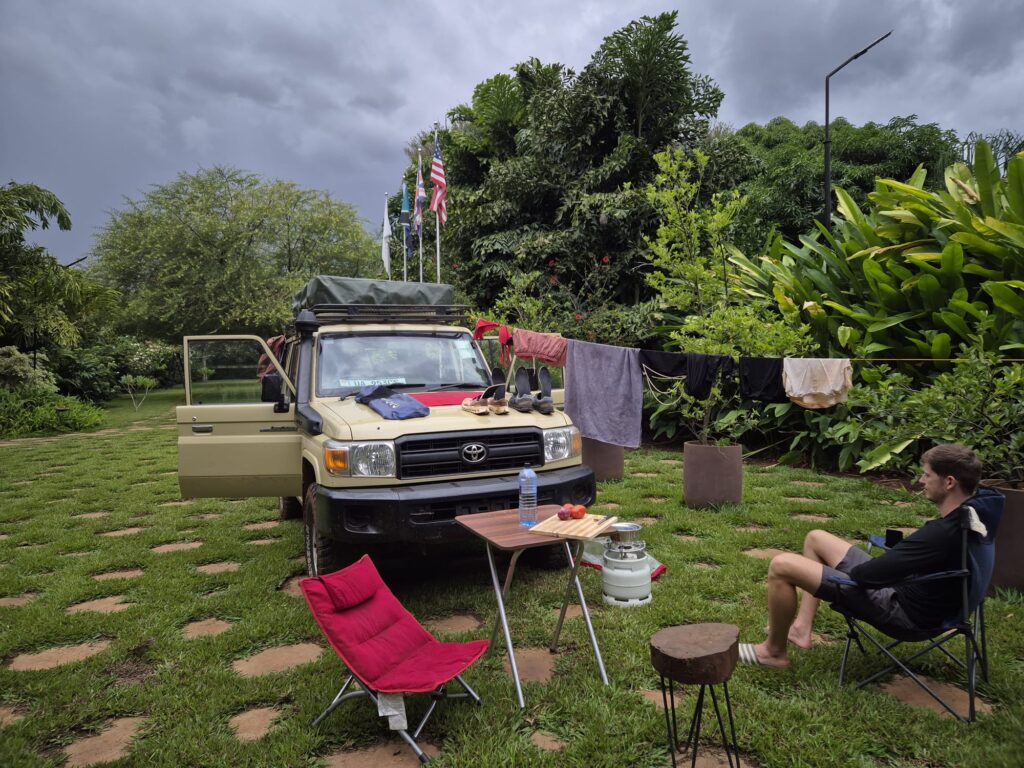
Kenya offers an unusually good spread of camping options for a rooftop-tent traveler, from formal public campsites inside national parks and reserves like: the Maasai Mara, Amboseli, Tsavo East and West, Samburu, Lake Nakuru and Naivasha all have designated public campsites to private and community-run conservancy campsites that often sit closer to the wildlife with fewer other vehicles around, to simple, well-run campsites in towns along the main routes for nights when you’re covering distance rather than staying inside a park. Public campsites inside parks are typically unfenced, which is part of the experience and part of why a rooftop tent, rather than a ground tent, is the standard choice for this kind of travel: you’re sleeping above ground level in an area where wildlife genuinely does move through camp at night. We brief every client about campsites along their planned route, including which ones need advance booking through Kenya Wildlife Service or the relevant county/conservancy office, and we’re glad to help you build a night-by-night camping plan as part of your quote rather than leaving you to work it out once you’re already on the road.
Best Destinations for a Rooftop-Tent Safari
The Maasai Mara is, unsurprisingly, the destination most rooftop-tent clients build their trip around — the wildlife density, the public and conservancy campsites, and the sheer scale of the plains make waking up inside the reserve genuinely unforgettable, particularly during the wildebeest migration months of July through October. Amboseli pairs elephant herds with the single best backdrop in East Africa, Kilimanjaro rising directly across the border, and its public campsites offer some of the clearest dawn views of the mountain anywhere in Kenya. Tsavo East and West, Kenya’s largest protected area, rewards travelers with a rooftop-tent set-up specifically because its distances and its famous red-dust elephants make lodge-hopping impractical, camping here means you’re not racing the clock between accommodation bookings. Samburu, further north and drier, offers a genuinely different landscape and species mix Grevy’s zebra, reticulated giraffe, gerenuk, and rewards travellers willing to push a little further from Nairobi. Lake Naivasha and Lake Nakuru, both within a half-day’s drive of Nairobi, make an excellent first or last camping stop on a longer loop, easing you into or out of the rhythm of the trip.
Rooftop Tent vs. Hotel or Lodge
A lodge or tented camp gives you a fixed roof, a restaurant, and someone else handling the logistics, a genuinely good option on certain nights of a trip, particularly if you want a shower with real water pressure or a night off from cooking. What it does not give you is control over your route: you’re booking accommodation days or weeks ahead, shaping your itinerary around availability and check-in windows rather than the other way around, and paying lodge rates that, across a two-week trip, run considerably higher than a self-drive camping rental. A rooftop tent flips that: your accommodation moves with you, you decide each morning where the day ends, and the cost profile, vehicle rental plus modest campsite fees rather than nightly per-person lodge rates makes a longer, more ambitious route financially realistic for a family or small group. Most of our clients don’t choose one over the other outright; they mix camping nights with the occasional lodge or coastal stay, which is easy to do with your own vehicle and impossible to do gracefully on a fixed group-tour itinerary.
Rooftop Tent vs. Ground Tent
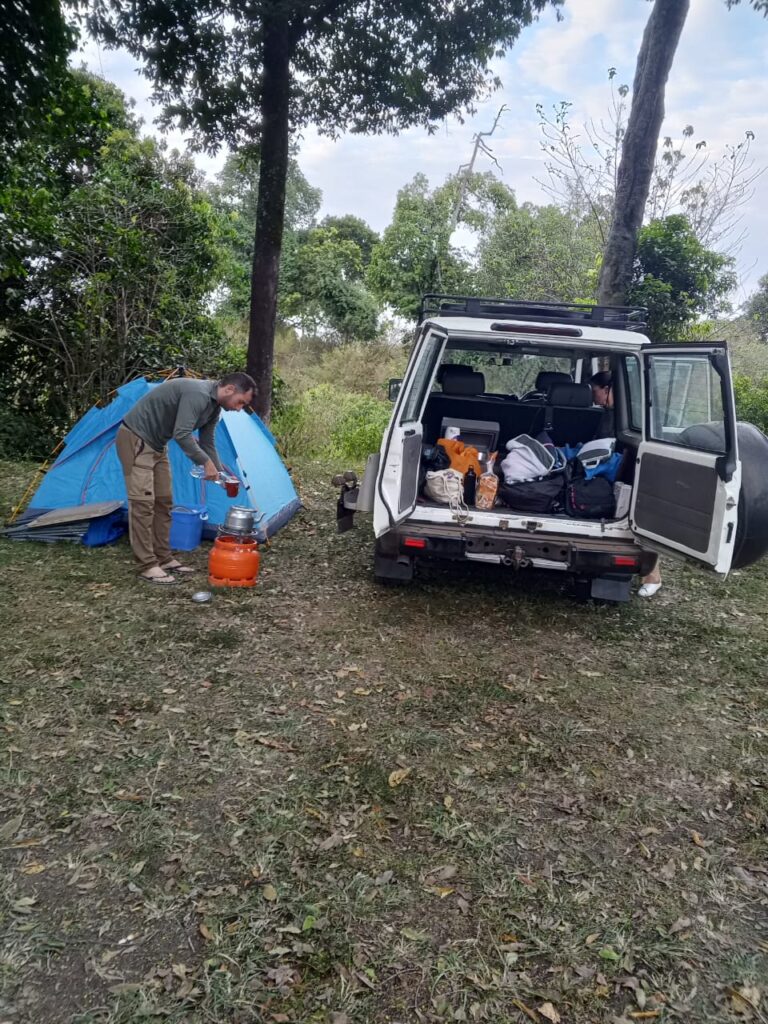 Both keep you camping rather than in built accommodation, but they solve different problems. A ground tent is cheaper to rent and doesn’t require a specific vehicle, but it takes real time to pitch and strike each day, needs reasonably flat, dry, obstruction-free ground, and the point that matters most in Kenya’s unfenced parks and conservancies — puts you at ground level in areas where wildlife moves through camp overnight. A rooftop tent sets up and packs away in minutes, keeps you and your mattress dry regardless of ground conditions, and puts a metre or more of vertical clearance between you and anything walking through camp at night. The trade-off is that it’s tied to a specific vehicle and roof rack, and you climb a ladder to get in, a genuinely minor adjustment for the vast majority of travelers, and the reason rooftop tents are the default choice for serious overlanding and safari self-drive travel across East and Southern Africa.
Is It Safe to Hire a Car with rooftop tent in Kenya?
Three separate questions usually sit inside this one, so we’ll answer them separately.
On wildlife: camping inside Kenya’s parks and conservancies, including in unfenced public campsites, is standard practice and has been for decades. The rooftop tent’s elevation is specifically why it’s the preferred format, and we brief every client on camp etiquette, including never leaving food out, keeping the vehicle closed at night, and using a torch before stepping down the ladder after dark.
On driving: Kenya’s road conditions range from good tarmac between major towns to genuinely rough, rutted or seasonally impassable tracks inside parks and in remote regions, and our vehicle choice, briefing and route guidance are all built around helping you drive those conditions safely rather than discovering them unprepared see the Driving in Kenya section below for the full practical guide.
On general road-trip safety: sticking to recommended routes, avoiding driving after dark outside towns, keeping our 24-hour contact number saved, and using the campsites and fuel-stop recommendations we provide covers the overwhelming majority of the risk a self-drive traveler actually faces. None of this is unique to camping. It’s the same guidance we give every self-drive client, tent or no tent.
Driving in Kenya: What to Actually Expect
Main highways between Nairobi and the major tourist circuits: the Nairobi–Narok–Mara road, the Nairobi–Mombasa highway, the routes to Naivasha and Nakuru are tarmac and, outside of occasional potholed stretches and slow-moving heavy trucks, straightforward for a confident driver. Once you turn off toward a park gate or into the reserves themselves, expect graded murram roads that turn to significant mud in the long and short rains (roughly April–May and November), sections of black-cotton soil that become genuinely difficult even in 4×4 when wet, and corrugated stretches that reward a lower tyre pressure and a steady, unhurried pace rather than speed. Night driving outside towns is something we actively discourage, wildlife on the road, unlit vehicles and poorly marked hazards make it materially more dangerous than daytime driving, and it’s rarely necessary if your itinerary is paced sensibly. Every vehicle leaves our yard with a full handover briefing covering 4×4 engagement, what to do in mud or sand, and how to use the recovery kit, and every rental includes our contact numbers for real-time route or road-condition questions while you’re out.
Insurance and Damage: The Part We Want You to Read Twice
Every Self Drive Kenya vehicle rental includes comprehensive vehicle insurance as standard, covering the vehicle itself against accident damage subject to the excess and terms set out in your rental agreement. The rooftop tent is a separate, purpose-built accessory bolted to the roof rack, and it sits outside that comprehensive vehicle policy under its own rooftop-tent damage liability. Meaning damage to the tent, its canvas, ladder, mattress or mounting hardware is handled under separate terms from a dent in the bodywork or a cracked windscreen, and is spelled out in full, in writing, before you sign. We are direct about this because it is the single most common source of confusion in rooftop-tent rentals across the industry, and we would rather a client understand the liability structure in our Nairobi office than discover it after an incident on the road. Practically, this means treating the tent with the same care as the vehicle, closing it fully before driving, avoiding low branches when parking, and using the ladder and ramps as briefed, and it means every rental agreement we issue explicitly names rooftop-tent and camping use, with the applicable liability terms attached, so there is never a gap between what you were told verbally and what the signed paperwork actually covers.
Breakdowns and Accidents: What Actually Happens
If a vehicle develops a mechanical issue on the road, your first call is our contact number, available for the full length of your rental, we talk you through basic troubleshooting first, since a surprising number of roadside issues resolve in minutes, and if it’s beyond that, we coordinate a mechanic or recovery to your location as quickly as the road and region allow. In the event of an accident, the process is the same as any Kenya self-drive rental: prioritise safety and medical attention first, contact us and, where required, the relevant authorities, document the scene, and follow the incident procedure set out in your rental agreement, we walk every client through this at handover so it’s familiar rather than a surprise if it’s ever needed.
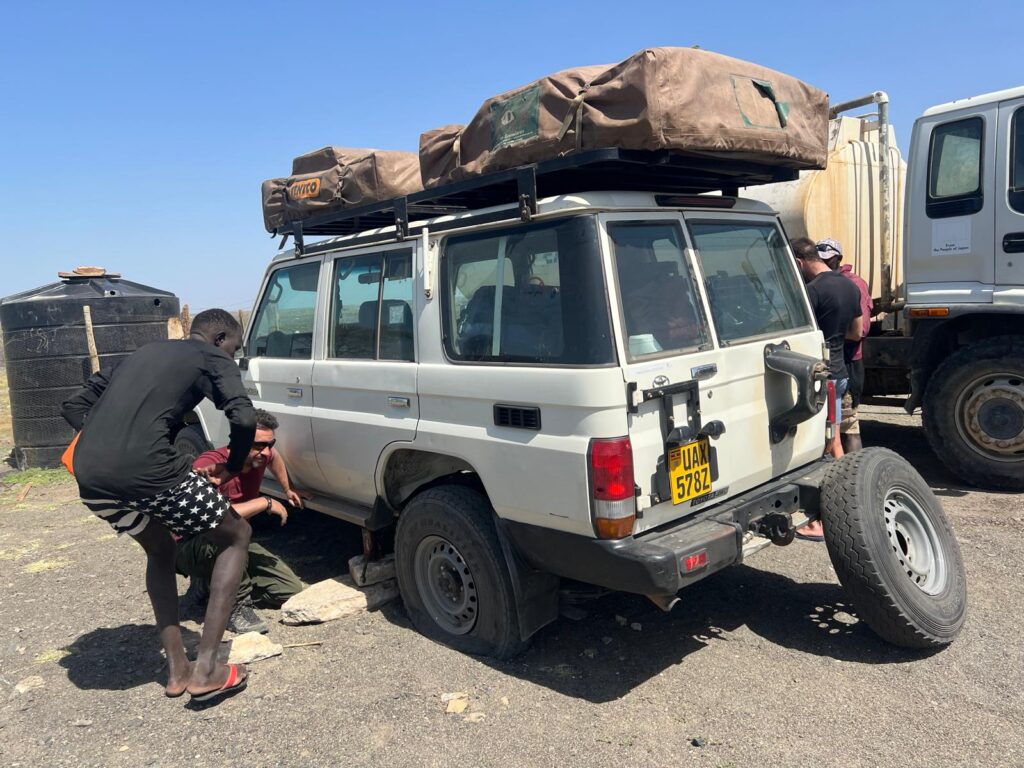
Vehicles are fitted with a full spare wheel and standard recovery kit, and our handover briefing covers basic self-recovery for the kind of mud or sand situations that are common, not exceptional, on Kenya’s park tracks.
Cross-Border Rooftop-Tent Travel: Beyond Kenya
For travelers who want to extend a Kenya camping safari into the wider East African circuit, pre-approved rentals can cross the border into Tanzania, Uganda and Rwanda, opening routes from the Mara across to the Serengeti, from Amboseli down to Arusha and Moshi beneath Kilimanjaro, or north through Uganda toward Kampala and Entebbe. Cross-border travel requires advance approval and the correct cross-border documentation. This is arranged as part of your booking, not something we hand you to sort out at the border yourself and we’re upfront that not every vehicle or route combination is approved for every border, so tell us the countries and route you’re planning as early as possible so we can confirm feasibility and paperwork before you build the rest of the itinerary around it.
One-Way Rentals Beyond Kenya’s Borders
Alongside standard round-trip rentals, we offer one-way rooftop-tent rentals with drop-off at a wider range of locations than most Kenyan operators support, not just within Kenya to Mombasa, Kilifi, Watamu, Voi or Emali, but, on approved routes, across the border to Namanga, Arusha, Dar es Salaam, Kigali, Kampala or Entebbe. This suits travelers building a one-directional East Africa itinerary — Nairobi to the Mara to Serengeti to Arusha, for instance, without the cost and time of driving the same route back. One-way rentals are quoted individually based on drop-off location and vehicle repositioning, so get in touch with your planned route and we’ll confirm pricing and feasibility.
Long-Term and Extended Rooftop-Tent Rentals
For travelers planning an extended overland trip, a month or more touring Kenya and neighbouring countries, or a longer-term rental for a working or volunteering stint that includes weekend camping trips, we offer long-term rooftop-tent rental rates that improve meaningfully on our standard daily pricing the longer the rental runs. Long-term rentals include the same vehicle preparation, insurance structure and support as a standard booking, with scheduled servicing built into the rental period so the vehicle is inspected and maintained at proper intervals rather than left to run the full trip untouched. If you’re planning six weeks or more in the region, tell us your rough dates and route and we’ll put together a long-term quote rather than pricing it as a series of short bookings.
Driver-Guided Rooftop-Tent Rentals
Not every traveler wants to self-drive, and not every route suits a first-time visitor doing it alone. This is where a driver-guide earns their place. A professional driver-guide handles the driving, navigation, park-gate logistics and, where relevant, cross-border paperwork, while you and your group focus on the trip itself, still sleeping in the same rooftop-tent set-up and still camping at the same sites a self-drive client would use. This is the format we recommend most for first-time visitors to Kenya, for families who want an experienced adult managing logistics, and for groups planning a longer or cross-border route where local knowledge measurably reduces friction. It’s quoted as a day rate on top of the vehicle and tent rental, and can be booked for the whole trip or just the first few days, with you taking over the driving once you’re comfortable with the vehicle and the roads.
Car Rental With Rooftop Tent + Customised Safari
For travelers who want the freedom of self-drive camping without designing the route from scratch, we build fully customised rooftop-tent safari itineraries around your dates, group size, budget and interests whether that’s a wildlife-focused Mara-and-Amboseli loop, a coast-and-bush combination, or a longer cross-border overland route. Tell us roughly what you’re picturing and we’ll turn it into a day-by-day itinerary with vehicle, tent configuration, campsite recommendations and costs attached, ready for you to adjust until it’s right.
Why Self Drive Kenya
We are not the cheapest rooftop-tent rental you will find advertised in Kenya, and we don’t try to be. What we offer instead is a fleet of Land Cruisers that are mechanically inspected and serviced on a fixed schedule rather than only between rentals, rooftop tents fitted and checked by the same team that maintains the vehicles rather than outsourced separately, a rental agreement that names rooftop-tent and camping use explicitly rather than leaving it implied, transparent damage-liability terms explained before you sign rather than discovered afterward, and a Nairobi-based team genuinely reachable for the length of your trip rather than a call centre reading from a script. Clients who’ve driven with us across the Mara, Amboseli, Tsavo and into Tanzania and Uganda come back for the second and third trip because none of that changes between bookings.
Our Vehicle Preparation
Every vehicle in our rooftop-tent fleet goes through a full mechanical inspection before handover,, that is to say: brakes, tyres, suspension, cooling system and 4×4 engagement all checked, not just glanced at. Alongside a check of the rooftop tent’s canvas, ladder, mounting hardware and mattress condition. Vehicles follow a scheduled maintenance interval through their service life rather than running until something fails, and any vehicle that doesn’t meet our internal standard at inspection is pulled from the rental fleet until it does. This is the same standard we’d want if we were the ones camping in the Mara three hundred kilometres from the nearest dealership, which, often enough, we are.
How Booking Works
Booking a rooftop-tent rental with Self Drive Kenya runs through ten straightforward steps:
- First, you tell us your travel dates, group size and rough route, whether within Kenya or across the border;
- Second, we recommend the vehicle and tent configuration: single, double or family, that best fits your group;
- third, we put together your camping equipment package based on how many nights you’ll actually be camping;
- Fourth, we send a full written quote covering the vehicle, tent, equipment, any driver-guide and estimated fuel and park costs;
- Fifth, once you confirm, we take a booking deposit to secure the vehicle for your dates;
- Sixth, we help you finalise a night-by-night route and flag which campsites need advance booking;
- Seventh, ahead of arrival we confirm your pickup time and location in Nairobi;
- Eighth, at handover we complete the rental agreement, explicitly naming rooftop-tent and camping use and the applicable insurance and damage-liability terms and run through the full vehicle and tent briefing;
- Ninth, you’re on the road, with our contact number active for the full length of your trip;
- Tenth, at drop-off we complete a joint vehicle and tent check-in so any issues are resolved on the spot rather than after the fact.
Frequently Asked Questions
What is a rooftop-tent rental?
It’s a self-drive vehicle rental where the accommodation, (a canvas tent mounted on the roof rack ), travels with the vehicle, so you camp wherever your day’s drive ends rather than booking fixed lodging in advance.
How many people fit in a rooftop tent?
A single tent suits one or two people, a double configuration effectively sleeps up to four across two compartments, and the family tent sleeps up to three in one expanded space.
Do I need previous camping experience to rent one?
No. We run a full handover briefing on tent set-up, vehicle operation and basic camp safety, and a driver-guide is available for clients who’d rather not self-drive on the first trip.
Is the rooftop tent covered by the vehicle’s insurance?
No, the tent sits under a separate rooftop-tent damage liability rather than the standard comprehensive vehicle insurance, and both are explained in full and named in your signed rental agreement before you drive off.
Can I take the vehicle into national parks?
Yes, our rooftop-tent vehicles are prepared specifically for park use, and park entrance and campsite fees are payable separately from the vehicle rental. Note that, No rooftop tent car rental is allowed/accepted in Masai Mara National Reserve, but accepted in the Mara Triangle also known as Trans Mara region
Can I cross into Tanzania, Uganda or Rwanda?
Yes, on pre-approved rentals with the correct cross-border documentation arranged in advance. Tell us your intended countries and route as early as possible in the booking process.
Can I do a one-way rental?
Yes, both within Kenya over to Mombasa, Kilifi, Watamu, Voi or Emali, among other locations, and, on approved routes, across the border to destinations such as Namanga, Arusha, Dar es Salaam, Kigali, Kampala or Entebbe.
What’s the best time of year for a rooftop-tent safari?
The dry seasons — roughly June through October and January through February — offer the easiest driving conditions and the best wildlife viewing, with July through October also covering the wildebeest migration in the Mara. The long and short rains (April–May and November) bring lush scenery and fewer crowds but genuinely tougher driving on murram and black-cotton roads, so a Land Cruiser LX or V8 with full 4×4 capability is the better choice for a rainy-season trip. Coastal legs of a route are pleasant nearly year-round, with the hottest, most humid stretch typically falling between December and March.
Get a Quote
Tell us your travel dates, your group size, whether you’re picturing a single, double or family rooftop tent, and the rough shape of your route ,Kenya only, or across into Tanzania, Uganda or Rwanda, and we’ll come back with a detailed, no-obligation quote covering vehicle, tent, equipment and any driver-guide you’d like included.
Or