
Car Rental With Camping Gear in Kenya
Explore Kenya on your own terms, with the vehicle and camping equipment you need for the journey.
Need a 4×4 with camping gear in Kenya? Rent a suitable 4×4 from Self Drive Kenya and add the camping equipment required for your trip, whether you’re traveling alone, as a couple, with family, or as a group. A self-drive camping safari gives you the freedom to leave the city behind, explore Kenya’s wildlife destinations, and spend nights at campsites along your route without having to bring bulky camping equipment from home.
Imagine waking up surrounded by Kenya’s landscapes, brewing coffee at your campsite, and continuing your journey toward the next wildlife destination, all without checking into a hotel every night. With a camping-equipped rental vehicle from Self Drive Kenya, you can build your own Kenya camping safari, pairing a 4×4 vehicle with the camping setup your journey needs. You choose where to go, you spend your nights at permitted campsites under an open sky, and you move through the country at a pace that belongs entirely to you.
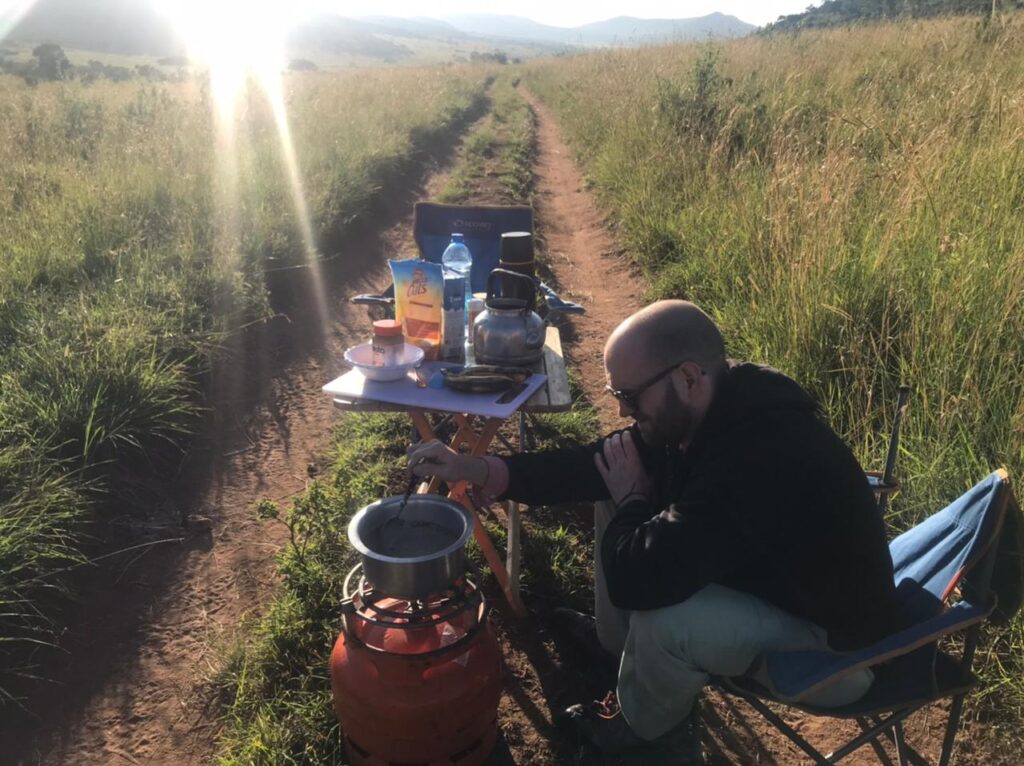
Whether you are travelling alone with nothing but a camera and a loose itinerary, as a couple looking for a private outdoor adventure, with a family ready to swap hotel corridors for campfire evenings, or with a group of friends splitting the cost of a proper road trip, you can choose a self-drive camping adventure or arrange a driver-guided camping safari. This is not simply a car with a tent strapped to the roof. It is the vehicle and equipment behind a genuinely different way of experiencing Kenya, one built around movement, landscape, and the outdoors rather than reception desks and fixed check-in times.
Can I Rent a Car With Camping Gear in Kenya?
Yes. Self Drive Kenya provides vehicles fitted out with camping equipment for travelers who are keen to explore the country rather than moving from hotel to hotel or lodge to lodge. Depending on the vehicle and camping configuration you choose, your rental can include the sleeping equipment and campsite gear you need for the nights of your journey, from a rooftop or ground tent through to cooking equipment, a table, chairs, and lighting. You can take the vehicle yourself as a self-drive camping trip or arrange a driver-guided camping safari if you would rather leave the driving and navigation to a local professional; both options are available subject to the applicable rental terms and vehicle availability at the time of booking.
Your Vehicle. Your Route. Your Campsite. You’re in Kenya.
Forget the idea that a Kenya safari has to mean checking into a lodge every evening. With a camping-equipped 4×4 from Self Drive Kenya, you can build a road trip around the places you want to see and the camping experiences you want to have. Our camping-equipped vehicles carry the essential setup you need for nights at campsites, so accommodation stops become part of the adventure rather than an interruption to it. Drive yourself if you want complete independence, or travel with a driver-guide if you would rather leave the driving and navigation to someone who knows the roads, the parks, and the campsites already. Either way, the aim is the same: to give you the freedom to experience Kenya beyond the hotel walls.

Camping Safari or Hotel Safari: Which Kenya Experience Is Right for You?
There is no single correct way to see Kenya, and the honest answer to “camping or hotel” depends on what kind of traveler you are and what you want the trip to feel like.
| Camping Safari | Hotel/Lodge Safari |
| Sleep at campsites. | Sleep in hotels and lodges. |
| Closer to nature | More conventional accommodation |
| More adventurous | More comfort and services |
| Flexible, road-trip experience | More structured itinerary |
| Cook some meals yourself, depending on the setup. | Meals generally provided |
| Can reduce accommodation costs depending on campsite | Accommodation can be a major trip cost. |
| Great for outdoor travelers | Great for travelers wanting comfort |
| Vehicle plus camping setup | Vehicle plus accommodation booking |
Choose camping if the journey itself is part of the adventure you are looking for. Choose hotels or lodges if accommodation comfort and full services are your priority. And if you want a combination, you don’t have to choose one exclusively; camping nights can be mixed with selected lodges or hotels across the same itinerary, giving you comfort on some nights and open-sky camping on others.
Why Choose a Camping Safari in Kenya?
The case for camping in Kenya is, at its core, a case for freedom. A camping-equipped vehicle removes the fixed check-in times, the booked-ahead itineraries, and the need to plan your whole trip around where hotel rooms happen to be available. You gain the freedom to explore, to change your route because you heard about a good sighting further down the road, to linger an extra night somewhere you didn’t expect to love, or to leave early if a place doesn’t suit you. You sleep closer to nature than any lodge allows, with the sounds of the bush audible through canvas rather than filtered through glass and air conditioning. It turns your trip into a genuine road-trip adventure, where the driving between destinations is part of the experience rather than a logistics problem to be minimized. Accommodation becomes flexible rather than fixed weeks in advance, and depending on the campsites you choose, camping can significantly reduce your accommodation costs compared to mid-range and upmarket lodges. Most importantly, camping gives you a more immersive experience of the country; you are not simply visiting Kenya’s landscapes from a vehicle window and a hotel balcony, you are living inside them for the length of your trip.
What Is a Kenya Camping Safari Really Like?
It’s worth being straightforward here, because camping in Kenya is not simply a cheaper version of a hotel stay; it is a genuinely different way of experiencing the country, with its own realities. Depending on your campsite, you may need to set up camp yourself on arrival, and campsite facilities vary considerably from well-run, fenced sites with hot showers to simpler, more basic setups with shared or limited bathroom facilities. Cooking may be your responsibility depending on the package you choose, using the stove and cooking equipment provided with your vehicle. Weather in Kenya can change quickly, particularly in the highlands and during the rainy seasons, and early mornings are a normal part of camping-safari life, since the best game viewing and the most comfortable driving hours both tend to fall early in the day. Dust is part of the experience on murram park roads; some routes involve genuinely rough driving conditions, and being close to wildlife means following sensible, responsible behavior around campsites at all times, including how food is stored and how close you allow yourself to get to animals. Campsites themselves range widely in standard, from simple public campsites within parks to more developed private sites with better facilities. None of this is meant to discourage you; it’s meant to set accurate expectations, because camping in Kenya rewards travelers who understand it is a different way of experiencing the country, not simply a budget alternative to a hotel bed.
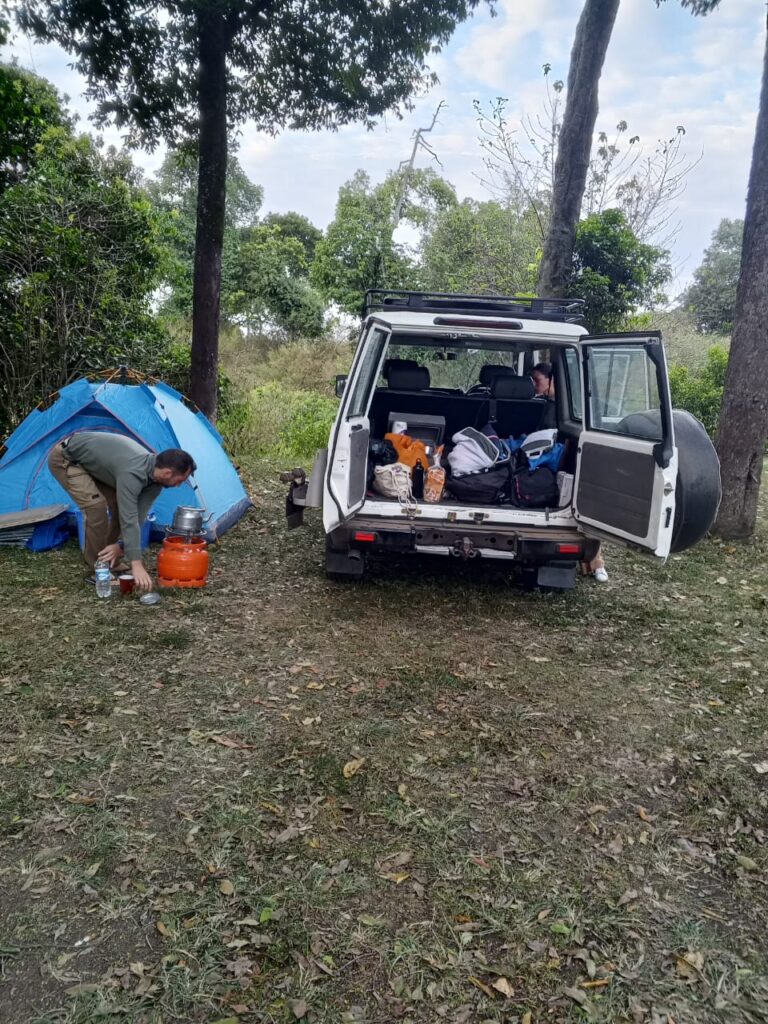
What’s Included With Your Camping Vehicle?
Rather than a shopping list, it’s more useful to think about what’s included in terms of the actual experience it supports, your vehicle, your sleeping setup, your campsite setup, and your cooking setup.
Your Vehicle
The foundation of every camping rental is a properly equipped 4×4 with genuine off-road and park-track capability, appropriate to the routes and terrain of your itinerary. Vehicle type is matched to your group size and route, whether that is a standard Land Cruiser, an extended configuration for larger groups, or another 4×4 suited to a budget-conscious road trip. Passenger capacity and luggage space are considered together, since a camping trip carries more gear than a hotel-based safari, and every vehicle offered for camping rentals is fitted with automatic or manual transmission as specified at booking, runs on the appropriate fuel type for that model, and includes air conditioning for comfort on long driving days. Safari suitability, ground clearance, 4×4 drivetrain, and general robustness for murram and park-track conditions are baseline requirements for any vehicle offered as part of a camping package, not optional extras.
Your Sleeping Setup
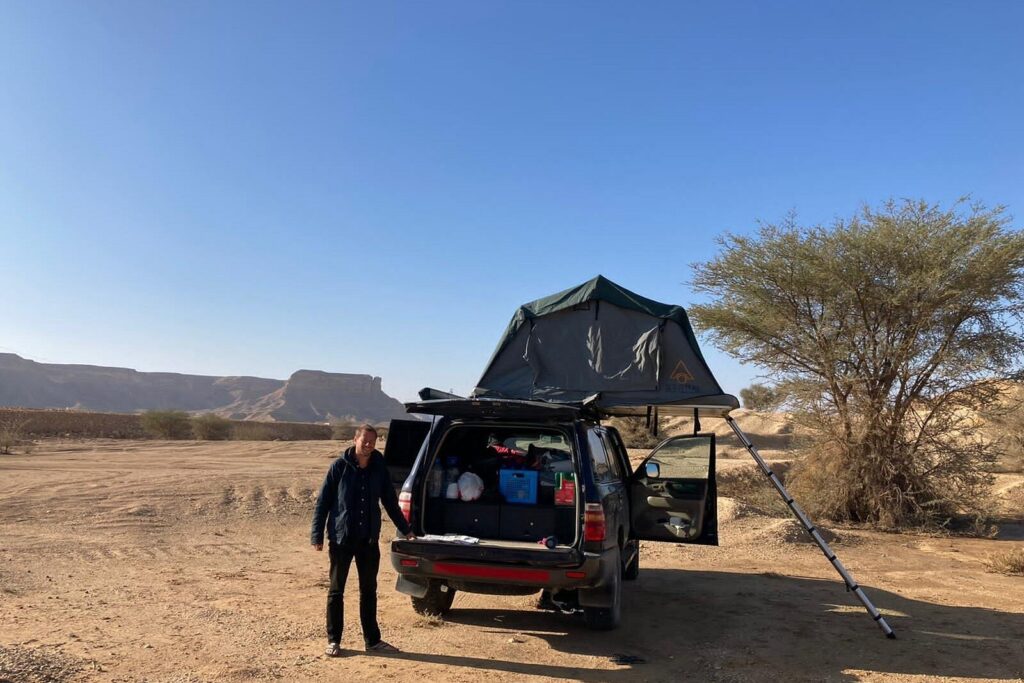
Depending on the configuration you choose, your sleeping setup may be a rooftop tent mounted on the vehicle itself or a ground tent packed as part of your camping equipment, along with a mattress and the bedding or sleeping equipment needed for the nights of your trip. Which option suits you best depends on your priorities: a rooftop tent keeps you elevated and quick to set up each evening, while a ground tent offers more space and a different camping feel, both are explained further in the vehicle comparison section below.
Your Campsite Setup
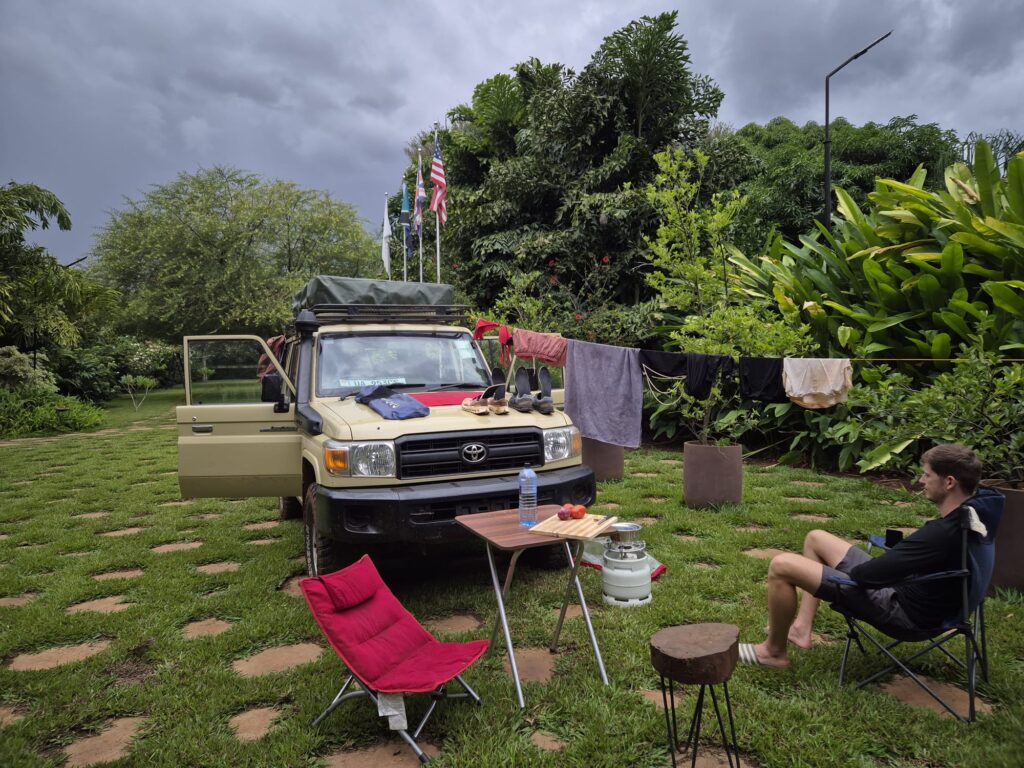
A proper camping safari needs more than somewhere to sleep. Depending on your package, your campsite setup includes chairs and a table for meals and evenings at camp, along with lighting to make the site usable after dark. This is what turns a parked vehicle into an actual camp.
Your Cooking Setup
Meals at camp are supported with a stove and the cooking equipment, utensils, and plates or cups needed to prepare and eat food at your site, depending on the package selected. The idea behind all of this is simple: everything is prepared for your camping adventure before you leave, so your first night at camp is spent enjoying the experience rather than working out what you forgot to bring.
Who Should Rent a Camping Safari Vehicle?
Solo adventurers renting a camping vehicle are usually chasing three things: freedom, nature, and independence, and a camping-equipped 4×4 delivers all three without the compromises of joining a fixed group tour. Couples find in a camping safari a private outdoor adventure that a shared lodge dining room simply cannot replicate: evenings at your campsite, your pace, and your own route. Families are drawn to the flexibility of a road trip and the genuine outdoor experience that gets children away from screens and into the landscape, while still offering the option of a driver guide if parents would rather not manage both driving and campsite logistics at once.
Friends travelling together tend to want the combination of adventure, shared costs, and flexibility that a group camping trip naturally provides, splitting vehicle and equipment costs across more people while still building their own itinerary.
And long-term travelers spending one to three weeks or longer exploring Kenya are often the group for whom camping makes the most sense financially and experientially. The longer your trip, the more a camping-based itinerary starts to outperform a purely lodge-based one, both in cost and in the sheer range of places you can realistically reach.
Is a Camping Safari Right for You?
Camping may not be the right fit if you want a genuinely luxury bed every single night of your trip, if basic or shared facilities are something you’d rather avoid entirely, if you don’t want to be involved in cooking, if you’d prefer not to participate in setting up and breaking down camp, if you specifically require hotel-style bathrooms and showers throughout your trip, or if outdoor living generally isn’t something you enjoy. None of that makes camping the wrong choice for Kenya; it simply means a different approach may suit you better. If you prefer comfort every night, a lodge-based safari may be the more appropriate choice. If you want a mixture of both, consider combining camping nights with selected lodge stays across the same itinerary, which is a genuinely popular way to travel and one the team can help you plan.
Self-Drive Camping Safari in Kenya
This is, for many travelers, the heart of the whole experience. A self-drive camping safari puts you fully in control of the journey. You decide where to stop, where to spend the night, how long to stay at each destination, and which places to combine into your route, all subject to park regulations, campsite availability, and the terms of your rental agreement. You drive yourself, which means understanding Kenya’s driving requirements before you set out, having a valid driving license recognized for use in Kenya, having comfort with left-hand-drive traffic conventions, and having a realistic sense of your experience level with unfamiliar roads. Navigation on major routes is straightforward, though park tracks and rural roads benefit from GPS support or offline mapping, both of which can be arranged with your rental. Road conditions range from good tarmac between major towns to murram and rougher terrain within and around parks, which is precisely what the 4×4 system on your vehicle is built to handle; engaging it correctly on loose or uneven surfaces is covered in your vehicle handover briefing. Park rules on driving times, off-track restrictions, and speed limits apply throughout, and safety on a self-drive camping trip comes down to sensible planning: arriving at your campsite before dark, carrying enough fuel and water for your route, and following the wildlife-safety guidance given at handover. You also manage your own campsite, setting up on arrival, cooking your meals if that’s part of your package, and breaking camp each morning before moving on. Self-drive camping is best suited to travelers who are comfortable driving in unfamiliar environments and taking responsibility for navigation, campsite routines, and their own day-to-day travel decisions.
Prefer Someone Else to Handle the Driving?
If self-driving isn’t the part of the trip you’re looking forward to, you can combine the same camping experience with a professional driver-guide, allowing you to focus entirely on the landscapes, the wildlife, and your campsite evenings without taking on the responsibility of driving and navigation yourself. This lets the same camping-equipped vehicle serve both self-drive campers and guided campers, and many travelers choose a hybrid approach, self-driving the more straightforward legs of a route and bringing in a driver-guide for the sections that benefit most from local knowledge, such as the Maasai Mara conservancies or a longer cross-border leg.
It’s also worth knowing, if your route crosses into Tanzania, that Kenyan driver-guides generally do not drive within Tanzania’s national parks, and the reverse is true for Tanzanian drivers in Kenya, so on cross-border camping itineraries, the vehicle, driver, and camping equipment typically transfer at the border, with a new driver-guide taking over on the other side. This is a normal part of cross-border camping-safari planning rather than an inconvenience, and the team can walk you through exactly how it works for your specific route.
Choosing Your Camping Vehicle
Vehicle choice for a camping safari comes down to group size, comfort priorities, and how you want your sleeping setup configured.
| Vehicle | Best For | Camping Setup | Travelers | Best Use |
| Land Cruiser V8 | Couples and small groups | Rooftop or ground tent (confirm at booking) | Confirm at booking. | Safari plus camping |
| Land Cruiser LX | Families | Rooftop or ground tent (confirm at booking) | Confirm at booking. | Multi-day safari |
| Extended Land Cruiser | Larger groups | Ground tent and full camping package (confirm at booking) | Confirm at booking. | Group camping |
| Other 4×4 options | Budget-conscious or smaller trips | Ground tent setup (confirm at booking) | Confirm at booking. | General road trip |
Exact sleeping configurations and passenger capacities vary by individual vehicle and should be confirmed at the time of booking, since the fleet is matched to demand and route rather than a single fixed spec across every car.
Is a Kenya Camping Safari Cheaper Than Staying in Hotels?
It would be dishonest to promise that camping is always cheaper; it depends on the campsites you choose, the vehicle and equipment package, park fees, fuel, food, and the overall route you build. What is fair to say is that camping can reduce accommodation costs compared with some lodge and hotel options, particularly over longer trips, since campsite fees are typically a fraction of even mid-range lodge rates. The total cost of a camping safari should be budgeted across vehicle and camping equipment rental, fuel, park entry fees, campsite fees, food, and any driver-guide fee if you choose the guided option, and the team can put together an example budget for your specific itinerary and group size once you have a route in mind, using current verified rates rather than generic estimates.
Don’t Fly to Kenya With a Suitcase Full of Camping Equipment
One of the most common mistakes first-time camping travelers make is over-packing camping gear they don’t actually need to bring. With a properly equipped camping rental, you can arrive with your personal belongings and use the camping setup provided as part of your vehicle. Depending on your package, you may not need to bring bulky items such as tents, cooking equipment, camping chairs, or other campsite essentials from home at all; carrying that kind of gear across long-haul flights adds weight, cost, and hassle you simply don’t need. We prepare the camping setup so you can concentrate on the journey, not on freight allowances.
What Does a Day on a Kenya Camping Safari Look Like?
Every route is different, but a typical day gives a clear sense of the rhythm. Around six in the morning, you wake at your campsite to the sounds of the bush rather than an alarm clock and hotel corridor. By half past six, you’re making breakfast and packing up camp for the day ahead. By seven, you’re on the road or heading into the park for a morning game drive, when wildlife activity is usually at its peak. Around midday, you return to camp or stop along your route, depending on your itinerary for that day. The afternoon might mean further exploring, some rest during the heat of the day, or continuing on toward your next destination.
By evening, you’re back at camp, and night brings dinner cooked at your own site under an open, star-filled African sky. This is an illustrative rhythm rather than a fixed schedule; your actual days will shift with your route, the season, and how much you want to move versus linger, and that flexibility is exactly the point of a camping safari.
Why Trust Self Drive Kenya With Your Camping Safari?
Trust on a camping trip comes down to knowing in advance exactly what you’re getting and exactly what will happen if something goes wrong. We provide the vehicle itself, a genuine, maintained fleet vehicle rather than a stock photograph, which you can see and inspect before departure. We provide the camping setup that goes with it, from tent and mattress through to cooking equipment, table, chairs, and lighting, matched to the package you’ve booked.

We explain the equipment before you leave, walking through the handover process described in full below so nothing about your gear is a mystery on your first night at camp. We provide clear rental terms, and the rental agreement is available for you to read in full before you sign anything. We explain exactly what happens if equipment is damaged in transparent terms rather than vague disclaimers, covered in detail further down this page. We explain vehicle insurance clearly, distinguishing it from equipment liability. We help you choose the appropriate vehicle and camping configuration for your specific trip, because not every traveler needs the same setup. We understand Kenya’s safari routes, campsites, and driving conditions from genuine on-the-ground experience preparing and handing over these vehicles. We offer both self-drive and guided options, so the choice is genuinely yours. And the fleet, the office, and the team behind this page are real and verifiable, not a booking platform with no fixed presence in the country.
Camping Handover Checklist
Before you drive away with a camping-equipped vehicle, the handover follows a clear, consistent checklist: the vehicle itself is checked, the spare tire is checked, camping equipment is counted against your package, the tent is checked for condition and completeness, the mattress is checked, cooking equipment is checked, the stove is checked and tested, the table and chairs are checked, lighting is checked, safety equipment is explained, and the rental agreement is reviewed together with you before you sign it. Nothing about your camping setup should be a surprise once you’re on the road; every item is confirmed with you in person before you leave.
Camping Equipment Liability: What You Need to Know
Our car rental agreement treats rooftop tents and camping gear separately from vehicle insurance in the event of damage, and it’s worth understanding exactly why and what that means for you. Vehicle insurance covers the mechanical and collision risk to the vehicle itself, under the terms agreed at handover, with an excess payable by the renter in the event of a claim. Camping equipment, the tent, mattress, cooking gear, table, chairs, and lighting, sits outside that core vehicle policy and is instead covered under separate accessory terms, because it is equipment attached to or carried within the vehicle rather than the vehicle itself. In practice, this means normal wear and tear on camping equipment through ordinary use is expected and not charged to you, while damage caused by misuse, negligence, or failure to follow the guidance given at handover is generally the renter’s responsibility. A security deposit is typically held against the camping equipment for the duration of your rental, and any damage should be reported as soon as it occurs rather than at return so it can be assessed and addressed properly. Replacement or repair charges, where applicable, are set out clearly in your rental agreement rather than left to be decided after the fact, and the whole point of reviewing the terms with you at handover, as covered in the checklist above, is so you know your responsibilities before you ever set up camp for the first time.
What Happens If Camping Equipment Is Damaged?
If equipment is damaged during your rental, what’s covered and what isn’t comes down to the same distinction: normal wear and tear from ordinary use is covered and not charged to you, while damage from misuse, negligence, or use outside the guidance given at handover is generally the customer’s responsibility, assessed against the deposit held for the equipment. Reporting damage as soon as it happens, rather than waiting until you return the vehicle, is the best way to keep the process straightforward; it allows the team to advise you immediately on next steps, whether that’s a simple repair, a replacement item sourced locally, or, in rarer cases, an adjustment to your deposit at the end of the rental. This transparency exists so that camping equipment liability never becomes the unpleasant surprise at the end of an otherwise excellent trip.
Camping Destinations Across Kenya
A well-planned camping route strings together Kenya’s major wildlife regions, each with its own camping character.
From Nairobi, most camping road trips begin, whether heading southwest toward the Mara or north toward Samburu.
The Maasai Mara offers the country’s best-known camping experience, with public and private campsites set against some of Africa’s most concentrated wildlife viewing, particularly during the wildebeest migration months.
Lake Nakuru combines a compact, easily reached park with forest-fringed campsites and strong rhino and flamingo viewing.
Lake Naivasha offers a gentler camping stop, with campsites along the lakeshore and easy access to Hell’s Gate for those wanting a walking or cycling safari alongside their driving days.
Amboseli National Park pairs campsites with some of the most photogenic elephant-and-Kilimanjaro views in the country.
Tsavo, split between its East and West sections, offers vast, open camping country in Tsavo East and denser, more volcanic terrain in Tsavo West.
Samburu, further north, rewards campers with a genuinely different, more remote landscape and wildlife found nowhere else in Kenya’s southern circuit.
And Ol Pejeta Conservancy, near Nanyuki, combines strong rhino and predator populations with well-maintained roads, making it an accessible camping destination for travelers building a central-Kenya route.
Each of these destinations has its own practical camping considerations, campsite standards, road conditions, and the best season to visit, and the team can talk you through route-specific camping guidance for wherever your trip is headed.
Long-Term, One-Way, and Combined Camping Rentals
Beyond a standard point-to-point booking, several extended options are worth knowing about. Long-term car rental in Kenya with camping gear suits travelers spending several weeks or longer road-tripping across Kenya, typically offering better daily rates the longer the booking runs.
One-way car rental in Kenya with camping gear means you are not locked into returning to Nairobi with all your equipment; drop-offs can be arranged within Kenya at Mombasa, Kilifi, Watamu, Emali, or Voi, and across the border at Namanga, Arusha, Dar es Salaam, Kigali, Kampala, or Entebbe, for travelers combining a Kenya camping safari with onward travel into Tanzania, Rwanda, or Uganda.
Camping gear paired with a rooftop tent car rental in Kenya is one configuration option, as covered in the vehicle comparison table above, while camping gear paired with a pop-up-roof car rental in Kenya is a different combination worth understanding because a pop-up roof is a wildlife-viewing feature rather than a sleeping platform; this pairing typically means a pop-up-roof Land Cruiser combined with a separate ground tent and camping equipment package, rather than a single roof doing both jobs. And for travelers who want the full picture, a Kenya self-drive-plus-safari-plus-camping itinerary can be built as one continuous trip, moving between parks, campsites, and even selected lodge nights on a single, custom route. Camping with a driver is also available for any of the above configurations for travelers who want the camping experience without having to drive themselves.
Best Time for a Kenya Camping Safari
Kenya’s dry seasons, broadly June through October and January through February, are the most popular windows for camping road trips, with firmer roads, more predictable weather at campsites, and, from July through October, the added draw of the wildebeest migration in the Maasai Mara. Camping is generally more comfortable during these months, with less risk of muddy access roads or wet nights at camp, though the peak season is also when demand across the whole rental and campsite market is highest, so booking ahead matters more than at any other time of year.
The shorter rains around November and the longer rains around March through May bring quieter parks, greener landscapes, and often better vehicle and campsite availability, though some park roads become more demanding in wet conditions and a driver-guide familiar with wet-season routes is worth considering during these months, particularly for longer or more remote camping circuits. Whichever season suits your dates, the vehicle and camping-equipment preparation described above stays the same, and the team can advise on route- and season-specific conditions once they know when you’re planning to travel.
Get Your Kenya Camping Safari Quote
Building an accurate quote starts with a handful of details about your trip: the number of travelers in your party, the number of days you’re planning to travel, your preferred vehicle type, your preferred camping setup (rooftop tent, ground tent, or another configuration), whether you’d like a driver-guide or plan to self-drive, which destinations you want to include, and roughly how many of your nights will be spent camping versus at a lodge or hotel if you’re combining the two. Share those details with the team, and they will put together a tailored quote and route for your trip rather than a generic package price.
Where can I camp with my Car Rental In Kenya?
Kenya has designated public campsites within most national parks and reserves, along with private campsites near park gates and conservancies that often offer better facilities. Your itinerary can be built around a mix of both, and the team can recommend specific sites for your route.
How much does Car rental with camping gear in Kenya cost?
Total cost depends on campsite fees, vehicle rental, park entry fees, fuel, food, and any additional equipment, rather than a single flat nightly rate; see the cost comparison section below for a fuller breakdown.
What camping equipment do I need for my Car Rental in Kenya?
With a fully equipped camping rental, your major equipment, including a tent with mattress, cooking gear, table, chairs, and lighting, is provided as part of the vehicle package, so you generally only need to bring personal items and clothing.
What vehicle should I rent with camping gear?
The choice depends on group size and route, as set out in the vehicle comparison table above; the team can confirm the right configuration once they know your numbers and destinations.
Is Car rental with camping gear in Kenya safe?
Yes, camping in Kenya’s designated sites is a well-established and safe way to travel when you follow the wildlife-safety and campsite guidance provided at vehicle handover and observe normal precautions around food storage and animal proximity.
Can I camp in Kenya National Parks with my Car Rental & camping gear?
Yes, most of Kenya’s major parks have designated public campsites, alongside private options nearby.
Can I camp in Maasai Mara with my Car Rental with Camping Gear?
Yes, the Mara has both public campsites and a range of private campsites within surrounding conservancies.
Can I camp in Amboseli with the Car Rental With Camping Gear?
Yes, Amboseli has designated campsites, including sites with views toward Mount Kilimanjaro.
Can I camp in Tsavo with a car rental with Camping Gear?
Yes, both Tsavo East and Tsavo West have public campsite options.
What should I pack with the car rental and camping gear?
Personal clothing, sun protection, a good torch, insect repellent, and any personal camera or electronic equipment, major camping gear is covered by your rental package.
How do I cook with my Car Rental with Camping Gear in Kenya?
You can use the stove and cooking equipment included with your camping setup, following the guidance given at your vehicle handover.
What happens when it rains?
Kenya’s rains, particularly the shorter and longer rainy seasons, can affect road conditions and campsite comfort; your route and campsite choices can be adjusted accordingly, and the team can advise on rain-appropriate planning for your travel dates.
What about toilets and showers?
Facilities vary by campsite, from simple long-drop toilets at more basic public sites to proper bathroom blocks with showers at better-developed private campsites; this variation is worth checking site by site when planning your route.
Can children go camping?
Yes, families regularly camp in Kenya with children, though facilities and driving days should be planned with younger travelers in mind, and a driver-guide is a popular choice for family camping trips for exactly this reason.
Can I self-drive?
Yes, self-drive camping is one of the most popular ways to experience Kenya, as covered in detail above.
Should I hire a driver guide?
If you’d rather focus on the experience than the logistics of driving and navigation, yes — a driver-guide is a strong option, particularly for first-time visitors or longer, multi-park routes.
Can I combine camping and lodges?
Yes, many travelers mix camping nights with selected lodge or hotel stays across the same itinerary, and the team can help plan exactly where that split makes the most sense.
How many days should I camp in Kenya with my car rental and camping gear?
This depends entirely on your route and interests; the sample itineraries above range from three to fourteen days and can be adjusted freely.
What happens if the vehicle breaks down?
Emergency procedures and contact details are explained at handover, and the team supports you in arranging recovery or a replacement vehicle as needed.
What happens if camping equipment is damaged?
This issue is addressed in detail in the equipment liability section below, which sets out clearly what is and isn’t covered.
Frequently Asked Questions
Can I rent a car with camping gear in Kenya?
Yes. Self Drive Kenya offers vehicles equipped with camping gear so travelers can experience Kenya as a camping road trip rather than staying in hotels or lodges throughout their journey, available as either a self-drive or driver-guided rental.
What’s included with a camping vehicle rental?
Depending on the package, your rental can include a rooftop or ground tent, mattress and sleeping equipment, a table and chairs for your campsite, lighting, and a stove with cooking. Equipment — all confirmed with you at handover before you leave.
Is camping in Kenya safe?
Yes, when following the wildlife-safety and campsite guidance provided at vehicle handover, camping at designated sites is a well-established and safe way to experience Kenya.
Can I self-drive a camping-equipped vehicle?
Yes, self-drive camping is one of the most popular ways travelers experience Kenya, giving you full control over your route, pace, and campsite choices, subject to park and rental restrictions.
Is camping cheaper than staying in hotels?
It can reduce accommodation costs compared with some lodge and hotel options, but total trip cost depends on your vehicle, campsite fees, park fees, fuel, food, and route, so it isn’t accurate to call camping universally cheaper.
What happens if camping equipment is damaged during my rental?
Normal wear and tear is expected and not charged to you; damage from misuse or negligence is generally the renter’s responsibility and is assessed against the deposit held for the equipment, as set out clearly in the rental agreement.
Can I combine camping with lodge stays?
Yes, many travelers mix camping nights with selected lodges or hotels across the same itinerary, and this approach is a popular way to balance adventure with comfort.
Can I drop the vehicle and camping gear somewhere apart from Nairobi?
Yes, one-way rentals are available, including drop-offs within Kenya and across the border into Tanzania, Uganda, and Rwanda, with driver-guides typically switching over at the border since Kenyan and Tanzanian driver-guides generally don’t cross into each other’s national parks.
Choose Your Kenya Camping Adventure
These itineraries are illustrative starting points rather than fixed packages, and every route can be adjusted for your pace, group size, and travel dates.
3-Day Camping Safari: Nairobi to Maasai Mara to Nairobi
This short camping loop covers roughly 270 kilometers each way between Nairobi and the Mara. A standard camping-equipped Land Cruiser with either a rooftop or ground tent suits couples and small families well on this route, with two camping nights at the Mara giving you a full day of game drives without the trip feeling rushed. Driving time runs five to six hours each way over a mix of tarmac and murram, and fuel and park fees should be budgeted for the return distance plus in-park game drives, alongside campsite fees at your chosen site. Road conditions require reasonable ground clearance on the murram sections, which the fleet’s 4×4 vehicles are built for, and this itinerary is well suited to both first-time and experienced self-drive campers, with a driver-guide available for those who would rather not navigate conservancy tracks alone on their first Kenya trip.
5-Day Camping Safari: Nairobi to Lake Nakuru to Maasai Mara
A five-day loop combining two of Kenya’s most accessible parks, with a two-to-three-hour drive from Nairobi to Nakuru followed by a four-to-five-hour transfer to the Mara. Four camping nights one at Nakuru and three at the Mara — gives the trip proper breathing room. A standard or extended camping vehicle works depending on party size, with tarmac conditions on the Nairobi-Nakuru leg and mixed tarmac-murram on the Nakuru-Mara stretch. This route suits confident self-drivers well, with a driver-guide recommended for families or first-time visitors managing camp logistics alongside driving.
7-Day Camping Road Trip: Nairobi to Amboseli to Tsavo to Nairobi
Covering roughly 240 kilometers from Nairobi to Amboseli and a further 150 to 200 kilometres between Amboseli and Tsavo, this circuit suits families and groups given the additional luggage and camping equipment involved, and an extended camping vehicle is the sensible baseline here. Six camping nights split between Amboseli and both Tsavo East and Tsavo West provide a genuinely immersive week, with road conditions varying from good tarmac to more demanding murram near park gates. Fuel, park fees, and campsite fees should be budgeted across three separate park entries, and this itinerary works well for both self-drive and driver-guided travelers.
10-Day Kenya Camping Safari: Samburu to Nakuru to Maasai Mara to Amboseli
A comprehensive circuit covering Kenya’s central, western, and southern wildlife regions, running roughly six hours from Nairobi to Samburu, five to six hours from Samburu to Nakuru, four to five hours from Nakuru to the Mara, and six to seven hours from the Mara to Amboseli before returning to Nairobi. Nine camping nights — two in Samburu, one in Nakuru, three in the Mara, and two in Amboseli—is the practical framework, best matched to an extended camping vehicle given the distance and terrain variation involved. This itinerary is one of the routes where a driver-guide adds real value, both for navigation across such varied terrain and for local knowledge of each region’s campsites and wildlife patterns, though experienced self-drive campers regularly complete it independently.
14-Day Kenya Camping Adventure
For travelers with two weeks or more, a longer circuit can combine all of the above into one extended road trip, typically running from Nairobi through Samburu, Nakuru, the Mara, Amboseli, and Tsavo before returning to Nairobi, with the option to extend across the border into Tanzania’s northern circuit. Thirteen or more camping nights across this route give you time to slow down at each destination rather than treating the trip as a checklist, and this is where the cost advantages of camping over a purely lodge-based itinerary tend to become most noticeable. Vehicle choice depends heavily on group size, and the team will work through a day-by-day structure with you covering driving distances, camping nights, park entries, and recommended pacing for a trip of this length.
Ready to Build Your Kenya Camping Safari?
If you’ve read this far, you already understand more about what a genuine Kenya camping safari involves — and what it actually feels like, day to day—than most travelers do before they book. That’s the point. A camping road trip through Kenya’s parks and campsites, or across its borders into Tanzania, Uganda, or Rwanda, should be shaped by the places you want to see and the way you want to experience them, not by uncertainty over what’s in the back of the vehicle or what happens if something goes wrong. Every camping-equipped vehicle goes through the handover checklist described above before it leaves the yard, every rental agreement is reviewed with you in person, and equipment liability is explained clearly rather than buried in fine print. When you’re ready, get in touch with your rough dates, group size, and the kind of route you’re imagining, and the team will help turn it into an actual Kenya camping safari — your vehicle, your route, your campsite, and your Kenya.
Fill out the Contact us form Below: